Showing posts with label YouTube Video. Show all posts

Monday, May 19, 2014

Brown Thrashers: Hide & Seek

In February, I spotted this bird as it perched upon winter branches near the huge Azalea tree.  I didn't know what species of bird it was so I had to do some research.  He (or She) is a Brown Thrasher, the only Thrasher bird species located east of Texas.  


I didn't see anymore Brown Thrashers until a couple weeks ago.  A pair of them were foraging through weeds and brush near the forest line.  Males and females are similar in appearance so I'm uncertain as to which one is which.  Since this is a pair, they're probably together for breeding season and they'll nest in the brush along the edge of the woods.  


Brown Thrashers spend most of their time near or on the ground, walking, running, or hopping. When disturbed at the nest, they drop to the ground and dart into dense cover. They feed by sweeping their long bills through leaf litter to uncover insects and other invertebrates. They are slow, short-distance fliers with a distinctive jerky, fluttering flight style. Brown Thrashers are monogamous during a breeding season, but it isn’t known whether pairs stay together from year to year. They breed in such dense vegetation that little is known of their courtship; the few observations that exist suggest that a courting pair presents each other with twigs or dead leaves, after which the male may briefly chase the female before mating. They defend territories of variable size, and they are very aggressive toward intruding Brown Thrashers and toward potential nest predators, which include snakes (racers as well as garter, king, rat, bull, and milk snakes) and dogs. Sometimes Brown Thrashers strike predators with their bills hard enough to draw blood.

I found it interesting that Brown Thrashers are accomplished songsters that may sing more than 1,100 different song types and include imitations of other birds, including Chuck-will’s-widows, Wood Thrushes, and Northern Flickers.  


Sweet music- reminds me of the Mockingbird songs...

Sunday, May 18, 2014

Eastern Bluebird Couple

A pair of Eastern Bluebirds have been seen frequently in our front yard so I'm assuming they've taken up residence close by.  I love the beautiful blue and bright orange plumage of these birds and they grab my attention when they're within my eyes view.  They often perch on the wooden fence near my bedroom, our roof gable or the power line in our front yard.  One time I spotted the female bluebird perched on the power line with a huge spider in her beak and I thought to myself,  "Have all the spiders your little heart desires".  ;)

Male Eastern Bluebird
Female Eastern Bluebird

Male Eastern Bluebirds are vivid, deep blue above and rusty or brick-red on the throat and breast. Blue in birds always depends on the light, and males often look plain gray-brown from a distance. Females are grayish above with bluish wings and tail, and a subdued orange-brown breast. The male Eastern Bluebird displays at his nest cavity to attract a female. He brings nest material to the hole, goes in and out, and waves his wings while perched above it. That is pretty much his contribution to nest building; only the female Eastern Bluebird builds the nest and incubates the eggs.  


Insects caught on the ground are a bluebird’s main food for much of the year. Major prey include caterpillars, beetles crickets, grasshoppers, and spiders. In fall and winter, bluebirds eat large amounts of fruit including mistletoe, sumac, blueberries, black cherry, tupelo, currants, wild holly, dogwood berries, hackberries, honeysuckle, bay, pokeweed, and juniper berries.

Eastern Bluebirds put their nests in natural cavities or in nest boxes or other artificial refuges. Among available natural cavities, bluebirds typically select old woodpecker holes in dead pine or oak trees, up to 50 feet off the ground. Older bluebirds are more likely than younger ones to nest in a nest box, although individual birds often switch their preferences between nesting attempts.

Here's what a bluebird song sounds like:


"Be like the bluebird who never is blue, 
for he knows from his upbringing what singing can do" ~ Cole Porter


Wednesday, May 14, 2014

Great Crested Flycatcher: Often Heard, Seldom Seen

While sitting on my back porch a couple weeks ago, I spotted yet another bird that I had never seen before. I grabbed my camera and got in a few shots before the bird disappeared.  This one was easier to research because of the distinctive colors of his plumage. 


According to the Cornell Lab of Ornithology as well as other resources, this feathered beauty is a Great Crested Flycatcher. They are common summer birds in thick hardwood forests and suburban areas with scattered trees throughout the eastern and central United States and southern Canada. Regular populations can be found as far west as Oklahoma, Nebraska and Texas. These birds migrate to the Gulf Coast of Mexico and throughout Central America in the winter, though year-round populations can be found in the southern tip of Florida.

Male and female birds look alike with a beige or olive green back and a darker gray head with a shaggy crest. The throat and upper breast are gray, while the abdomen and undertail coverts are bright yellow. There are two narrow white wing bars on the drab wings, and both the wings and tail show rufous underparts when flying.

These birds are sit-and-wait predators, sallying from high perches (usually near the tops of trees) after large insects, returning to the same or a nearby perch. Their clear, rising reep calls are a very common sound in summer.  Though they’re flycatchers, these birds also eat a fair amount of fruit. Instead of picking at the flesh of small fruit, Great Crested Flycatchers swallow the fruit whole and regurgitate the pits, sometimes several at a time.The Great Crested Flycatcher is a bird of the treetops. It spends very little time on the ground, and does not hop or walk. It prefers to fly from place to place on the ground rather than walk.

Great Crested Flycatchers weave shed snakeskin into their nest. Where it's readily available, as in Florida, nearly every nest contains snakeskin. They also seem to look for flimsy, crinkly nest materials—they’ve also used onion skins, cellophane, or plastic wrappers.


Now that I'm familiar with some of his calls, I'll keep my ears and eyes open...maybe, just maybe, I'll be lucky enough to get a few more snapshots, or even a video :)


Saturday, April 19, 2014

Indigo Buntings: Bright Blue Beauties

I've occasionally spotted these brightly colored blue birds throughout the last several years but didn't know much about them.  Since there have been several of them migrating through this area lately, I decided to do some research on these beautiful birds...

Cool facts about Indigo Buntings- they are sometimes nicknamed "blue canaries" because they whistle cheery songs through late spring and summer throughout eastern North America. They migrate at night, using the stars for guidance and they may travel up to 1,200 miles during migration from northern South America. Indigo Buntings eat seeds, berries, buds and insects. Common seed forage includes thistles, dandelions, goldenrods, and grain such as oats; berries eaten include blueberries, strawberries, blackberries, serviceberries, and elderberries. Spiders and insect prey, which form the majority of their diet during summer months, may include caterpillars, grasshoppers, aphids, cicadas and beetles such as canker worms, click beetles, and weevils. They are often mistaken for the Blue Grosbeak, another blue bird with similar characteristics.


Indigo Buntings are small (roughly sparrow-sized), stocky birds with short tails and short, thick, conical bills. In flight, the birds appear plump with short, rounded tails. Juvenile males have a "patchy" appearance during which time they are in a molting phase, until about their second year.  A breeding male Indigo Bunting is blue all over, with slightly richer blue on his head and a shiny, silver-gray bill. Females are basically brown, with faint streaking on the breast, a whitish throat, and sometimes a touch of blue on the wings, tail, or rump.

Their song was captured on video by The Music of Nature:


I am glad to be hosting these beautiful birds...I hope they will hang around through summer.  Right now there are about 6 or 7 of them that visit our feeders daily.  Aren't they gorgeous?  :)))))

Monday, February 17, 2014

Red-Bellied Woodpecker: Daily Visitor

Mention the word "woodpecker" and my mind instantly replays short memories of a certain little television character- Woody the Woodpecker.  Woody was a popular cartoon series in the 1950's and 1960's and I can still remember watching him and his funny friends on our black and white television set.  I remember the time that my Daddy Charles helped me order a plastic Woody figurine using a cut out cardboard form from a cereal box.  Daddy Charles and Uncle Shelby pitched in to help pay for the shipping...seems like it was only 25 cents.   A quarter went a long way in those days.

Now, a certain little woodpecker comes to visit us nearly every day.  I've observed her several mornings while sitting on the back porch or from my bedroom window.  She is often seen in our back yard first, where she pecks on the tree limbs or the wooden light pole.  Minutes later, she is in the front yard where she makes rounds between the wooden walkway rails to a certain tree near the walkway.  She usually pecks at the same hole on the tree, day after day.  I recorded her briefly a few days ago while she made the routine rounds.  I was trying to figure out if she was trying to hide bird seeds in the tree trunk or using the tree trunk to break the seeds into smaller pieces.   She pecked away busily for several minutes before flying off.  

This little feathered friend of mine is a Red-Bellied Woodpecker.  I know she's a she because of the color patterns on her head.  Males have a red cap that covers the entire top of their heads whereas the female's cap only covers a portion of it and the rest is filled with gray.  Isn't she beautiful?  My photos are a little blurry because I was taking them from inside my bedroom window where I can easily observe her.  


Here's a short video I captured of her from my bedroom window:


I watched this great video of a family of Red-Bellied Woodpeckers- 
the narrator, Samuel Kulp, did a wonderful job of documenting the bird family while giving interesting information on this species of woodpeckers. 


I would love to have a woodpecker family so close...
with luck our little female might just find a partner right here in our own front yard...


Sunday, February 16, 2014

Return of the American Robins

I've been expecting to see the return of the Robins soon, and they were right on time.  Each year, about mid to late February, flocks of them are seen on lawns and forest edges throughout the South.  Most are on their return journey to the North for Spring breeding.   Although they're year round residents of the United States, Robins spend most of the winter months near the coastal areas or in dense forests where winter berries are abundant.  I usually don't see them until late winter and then it seems they're here for just a short while.


The Robins kept their distance as I tried to get closer to them.  The above photos have been heavily cropped for a better view of their rusty orange colored breasts, white underparts and dark gray heads.  I watched them for a little while as they foraged the front lawn.  

Through online reading, I've learned that Robin roosts can be huge, sometimes including a quarter-million birds during winter...wow!  However, mortality rates are very high among this species.  It's estimated that the entire population of American Robins turns over on average every 6 years.  On average, only 40 percent of nests successfully produce young. Only 25 percent of those fledged young survive to November. From that point on, about half of the robins alive in any year will make it to the next.

Additionally, I've learned that when foraging on the ground, the American Robin runs a few steps, then stops abruptly. In long grass, robins may hop or fly just above the ground powered by slow, powerful wing beats. American Robins often find worms by staring, motionless, at the ground with the head cocked to one side. Robins sometimes fight over worms that others have caught. During fall and winter robins often roost in large flocks and spend much more time in trees. In spring, males attract females by singing, raising and spreading their tails, shaking their wings and inflating their white-striped throats. When pairs are forming in spring, you may see a display in which a male and female approach each other holding their bills wide open and touching them. 

Video of American Robin singing/foraging/collecting nest materials:


Saturday, February 15, 2014

Brown-Headed Cowbirds: Nuisance at the Feeders

One day I noticed an odd looking black bird mixing with other birds at the feeders. Taking a closer look, I noticed the black bird had a bluish tint all over except for his head, which was brown.  Soon after, a plain brown bird was next to him, looking for seed.  I was unfamiliar with these type of birds and decided I would do some research on them later.

The following day, there were at least half a dozen of these birds at the feeders.  The next day, there were a couple dozen at the feeders, and they barely allowed enough room or food for the smaller birds.   After some research, I learned these birds are Brown-Headed Cowbirds, also known as parasitic birds.  In other words, the Brown-headed Cowbird is North America’s most common “brood parasite.” A female cowbird makes no nest of her own, but instead lays her eggs in the nests of other bird species, who then raise the young cowbirds. Cowbirds are not monogamous. Studies show that males and females have several different mates within a single season.  Some birds can recognize cowbird eggs but are too small to get the eggs out of their nests. Instead, they build a new nest over the top of the old one and hope cowbirds don’t come back. Some larger species puncture or grab cowbird eggs and throw them out of the nest. But the majority of hosts don’t recognize cowbird eggs at all.  Cowbird eggs hatch faster than other species eggs, giving cowbird nestlings a head start in getting food from the parents. Young cowbirds also develop at a faster pace than their nest mates, and they sometimes toss out eggs and young nestlings or smother them in the bottom of the nest.  In winter, Brown-Headed Cowbirds may join huge roosts with several blackbird species. One such mixed roost in Kentucky contained more than five million birds. (Information from www.allaboutbirds.org)


Certainly I would rather not have these pesky birds around, but I haven't figured out yet how to provide food for the other birds without inviting cowbirds.  Ryan's solution- "you want me to shoot em for ya?"...Ummmm, no Ryan, that won't be necessary but thank you for offering some assistance.  I'm going to observe the bird activity in our front yard a few more days and see if further steps are necessary. Hopefully they will find an easy food source somewhere else.


The mostly brown birds in the photos are female cowbirds.  Male Brown-Headed Cowbirds have glossy black plumage and a rich brown head that often looks black in poor lighting or at distance. Female Brown-Headed Cowbirds are plain brown birds, lightest on the head and underparts, with fine streaking on the belly and a dark eye.

Brown-Headed Cowbirds feed on the ground in mixed-species groups of blackbirds and starlings. Males gather on lawns to strut and display for mates. Females prowl woodlands and edges in search of nests. Brown-Headed Cowbirds are noisy, making a multitude of clicks, whistles and chatter-like calls in addition to a flowing, gurgling song.

Video of female cowbird captured from my bedroom window:


Video of male/female courtship (not mine):


Friday, February 14, 2014

Red-Winged Blackbird

In the past, I haven't paid much attention to blackbirds.  Recently, however, I've acquired an interest in all of our local birds.  A sudden flash of color grabbed my attention and I focused in on this blackbird.  I later did some research and discovered that he is a Red-winged blackbird, common to our state.

The male Red-winged blackbird is hard to mistake.  Look for red and yellow shoulder badges upon an even, glossy black body.  On the other hand, the female of this species looks nothing like the male- she is dark brown overall with crisp streaks.  Though I haven't photographed a female yet, I did capture only one decent image of a male...because it is winter, his red shoulder badge is barely visible.  During breeding season, his shoulder badges are prominent and colorful.


According to articles I've read, the Red-winged Blackbird is a highly polygynous species, meaning males have many female mates – up to 15 in some cases. In some populations 90 percent of territorial males have more than one female nesting on their territories. But all is not as it seems: one-quarter to one-half of nestlings turn out to have been sired by someone other than the territorial male.  

Also, the males fiercely defend their territories during the breeding season, spending more than a quarter of daylight hours in territory defense. He chases other males out of the territory and attacks nest predators, sometimes going after much larger animals, including horses and people.   Red-winged Blackbirds roost in flocks in all months of the year. In summer small numbers roost in the wetlands where the birds breed. Winter flocks can be congregations of several million birds, including other blackbird species and starlings. Each morning the roosts spread out, traveling as far as 50 miles to feed, then re-forming at night.  

This video shows how male Red-winged Blackbirds appear during breeding season- they look like they could be pretty darn aggressive, especially when they get all puffed up and belch out their loud calls!


Video by The Music of Nature on YouTube


Wednesday, February 12, 2014

White-Throated Sparrow

I adore the beautiful things of our earthly home.  Mountains, forests, lakes, the moon, flowers...and birds. I see them all as gifts.   Thank you, God for the wonderful creations you have given us to enjoy!

Just look at the natural beauty of this White-throated Sparrow...


The White-throated Sparrow breeds mostly in Canada but during winter they are known to migrate into the United States.  What I find interesting about them is that the White-throated Sparrow comes in two color forms: white-crowned and tan-crowned. The two forms are genetically determined, and they persist because individuals almost always mate with a bird of the opposite morph. Males of both color types prefer females with white stripes, but both kinds of females prefer tan-striped males. White-striped birds are more aggressive than tan-striped ones, and white-striped females may be able to outcompete their tan-striped sisters for tan-striped males.

Too bad they're not that common in my neck of the woods.  I had the fortune of watching this one for a little while as he nibbled on a few seeds near my front porch.  I was able to capture a few images of him on my digital camera.  That was the first, and last, time I've seen this species of Sparrow in my yard.   How unfortunate because he is such a beauty!  These birds have a pleasant song as well...


Video by The Music of Nature on YouTube


Tuesday, February 11, 2014

Chipping Sparrows: Daily Visitors

I can depend on seeing these little birds every day at our feeders, mostly foraging around on the ground but sometimes picking seeds off the porch rails.  They are cute with the characteristic tan or white and black stripes around their eyes, rusty brown caps, short beaks and round bodies.  I've read that during summer Chipping Sparrows look clean and crisp, with frosty underparts, pale face, black line through the eye, topped off with a bright rusty crown. During winter, they are subdued, buff brown, with darkly streaked upper parts. The black line through the eye is still visible, and the cap is a warm but more subdued reddish brown.


Chipping Sparrows are one of the first sparrow species to nest during spring.  The males loud, trilling songs are one of the most common sounds of spring woodlands and suburbs.  I'm expecting to hear their songs soon, as the mating season is just around the corner...

Here what the males "trilling song" sounds like:


Chipping Sparrows typically build their nests low in a shrub or tree, but every once in a while they get creative. People have found their nests among hanging strands of chili peppers, on an old-fashioned mower inside a tool shed, and on a hanging basket filled with moss.  The nest of the Chipping Sparrow is of such flimsy construction that light can be seen through it.

Particularly in fall and winter, watch for small flocks of Chipping Sparrows feeding on open ground near trees. In spring and summer, listen for the male’s long, loud trill, then look for the male in the upper branches of a nearby tree.

Friday, February 7, 2014

Northern Mockingbird: Brief Guest at the Feeder

I was surprised to see a Mockingbird at the feeder a couple days ago.  Even more surprised that it stayed long enough for me to capture a photo.  I suppose it was curious...it wanted to see what all the fuss was about, what had attracted dozens of other birds near our front porch.  
I've seen a couple of Mockingbirds in a thinly forested area near the tree line that runs parallel to our driveway, several hundred feet away.  Within a few yards of that general area are holly trees with abundant bright red berries.  Mockingbirds and Blue Jays are both fond of these berries which provide an important food source during the late winter months.  I've taken notice that jays are often seen in that same area.  

Rarely do Mockingbirds visit our feeders so it was nice to have this little guest for a few moments.  


If you’ve been hearing an endless string of 10 or 15 different birds singing outside your house, you might have a Northern Mockingbird in your yard. These slender-bodied gray birds apparently pour all their color into their personalities. They sing almost endlessly, even sometimes at night, and they flagrantly harass birds that intrude on their territories, flying slowly around them or prancing toward them, legs extended, flaunting their bright white wing patches.

The Northern Mockingbird enjoys making its presence known. It usually sits conspicuously on high vegetation, fences, eaves, or telephone wires, or runs and hops along the ground. Found alone or in pairs throughout the year, mockingbirds aggressively chase off intruders on their territory.  Northern Mockingbirds are common in backyards, but they don’t often visit feeders. You can encourage mockingbirds to visit your yard by keeping an open lawn but providing fruiting trees or bushes, including mulberries, hawthorns, and blackberry brambles.

The above information came from the Cornell Lab of Ornithology and is posted at www.allaboutbirds.org.  


As I was taking a stroll and approached the other side of our fence line the other day, I heard this mockingbird call then I watched as it flew from the tree to perch upon a cable above the tree line.   It watched my every move as I strolled along the edge of the tree line and briefly perched upon the fence for a few seconds then flew into a nearby tree.  

Audioclip of a Mockingbird singing at night...


I love to hear the many variations of songs from these birds!


Monday, February 3, 2014

A Tufted Titmouse Visits

These little birds are less common in my yard than the goldfinches and chickadees.  They come to visit daily, but I've only seen a couple at a time.  Tufted Titmice have the prettiest eyes, which really stand out on their small pale gray faces.  They appear to have mascara on because of the dark coloration around their eyes.  

Tufted Titmice flit from branch to branch of the bare trees in our front yard, often darting to the feeder to snatch a seed.  When they find large seeds, such as sunflower seeds, they typically hold it with their feet and hammer it open with their beaks. In fall and winter they are known to hoard shelled seeds in bark crevices. These acrobatic foragers often hang upside down or sideways as they investigate cones, undersides of branches, and leaf clusters. They sometimes come all the way to the ground to hop around after fallen seeds or insects. Titmice are very vocal birds and are also quick to respond to the sounds of agitation in other birds, coming close to investigate or joining a group of birds mobbing a predator.


From what I've read about them, Tufted Titmouse pairs do not gather into larger flocks outside the breeding season. Instead, most remain on the territory as a pair. Frequently one of their young from that year remains with them, and occasionally other juveniles from other places will join them. Rarely a young titmouse remains with its parents into the breeding season and will help them raise the next year's brood.  Tufted Titmouse are regulars at backyard bird feeders, especially in winter. They prefer sunflower seeds but will eat suet, peanuts, and other seeds as well. They build their nests in cavities, so putting up nest boxes is a good way to attract breeding titmice to your yard.

Video of Tufted Titmouse calling its mate (His song changes at 1:15 on the video and you can clearly hear peter peter peter peter, their known call).


Sweet!

Sunday, February 2, 2014

Sweet Carolina Chickadees

I'd enjoy having more of these adorable chickadees around.  A couple of them will visit the feeders daily but I've never seen more than two at one time.  Carolina Chickadees are more sociable than the other birds- when outdoors, they will come within a few feet of me and my camera.  The chickadee prefers to grab a seed then fly to a nearby limb to eat it alone.  He's fast as lightening, however, so I have to be quick when I want a photo.  I've managed to get a few good close-ups of him, or her.  


The Carolina Chickadee is the only chickadee in the southeast.  During winter they associate with other small birds such as warblers, nuthatches, woodpeckers and titmice.  In early spring, they begin separating into pairs to breed.  The bonds between male and female lasts from years to a lifetime.  Each chickadee flock member has a rank; once spring arrives, the highest ranking individuals will nest within the flock’s territory; lower ranking birds must travel farther to successfully claim a territory and many don’t nest that season. Throughout the year, members of pairs, families, and flocks communicate with one another constantly.

Carolina Chickadees actively defend an individual space, keeping at least 2.2 feet, and sometimes at least 5 feet, between individuals; when two are closer than that, the dominant bird may make gargle calls. At feeders, each bird typically takes a seed and carries it to a branch somewhat isolated from other chickadees to eat.  I've often watched them do this.

Enjoy this video with Chickadee songs in the background:


They are so precious :)


Saturday, February 1, 2014

Northern Cardinals: Among My Favorite Birds

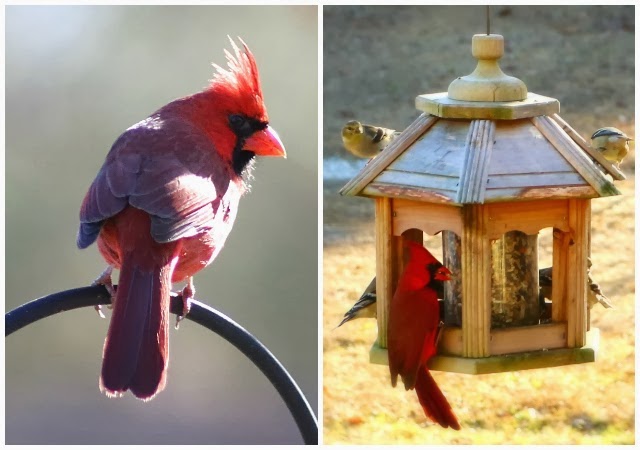
A few of these beautiful birds frequent our feeders daily.  A few days ago, I counted 4 males and 2 females feeding within 20 feet of each other.  However, the males are known to be territorial and fairly aggressive and will often attack each other.   I've witnessed that regularly.  It isn't as easy to capture photos of the cardinals because they will keep a distance when I'm outdoors.  Usually they will fly to trees on the other side of our driveway and perch there, watching me, waiting for me to go away.   If I'm dressed in dark colors and sit very still for several minutes, they'll eventually come close enough for me to capture a few shots.  They are smart and very observant...if I move only a few inches, they know it.  

The cardinals are usually the first birds to arrive at feeders in the early morning and the last to leave in the evening.  They prefer to dine when there isn't much competition from other birds. I've also noticed they prefer to eat on the ground or porch rails.  I think their size makes it difficult to eat from the feeders.  I read that these birds like platform feeders, so come spring I plan to purchase one.  


Cardinals are among my favorite birds.  I love watching the bright reds of the males swoop around our trees and hop along the porch rails.  In spring and summer, their songs are as beautiful as their plumage.  Northern Cardinals sing about twenty or so different tunes according to expert birders.  It's wonderful to sit on the porch in the early mornings, sip on a good cup of coffee and listen to the peaceful songs of the Cardinals.


Listen....