Showing posts with label Moths. Show all posts

Friday, November 4, 2016

Banded Sphinx Moth Caterpillar

While walking along the lake's edge during our visit to St. Catherine Creek NWR, I happened to spot a caterpillar curled up in one of the grassy plants.  Its size (about 3 inches long) surprised me and I broke off the small stem the caterpillar rested on so I could get a closer look.  I haven't seen many caterpillars in my life and I had no idea what kind of moth or butterfly this one would eventually morph into.  


Of course, Google search provided an answer.  This is a Banded Sphinx Moth caterpillar, a common species in the southeastern part of the United States.   Host plants include primrose-willow and other plants in the evening primrose family.  An adult moth has a wing span of approximately 3.5 inches. Photos and more information about the sphinx moth can be found here.  

Have a wonderful weekend!!!


Monday, May 30, 2016

Rosy Maple Moth

This colorful moth decided to fly indoors without realizing the danger within- like the crazy cat that chases and kills every little thing that moves or the dog that sometimes gets the urge to snap at flying insects.  After a few minutes to trying to capture it without causing injury, my grandson finally succeeded- I was able to snap a quick shot of the moth on the tip of his finger before he released him on our back porch.  


Have a wonderful Monday and a great week!


Tuesday, April 28, 2015

Luna Moth

While relaxing with a cup of java on the back porch a few nights ago, I was startled by the rapid, crazed movements of a giant moth as it fluttered around the porch light.  It took several seconds for the moth to secure a comfortable spot on the weathered back door.  He stayed in the same spot for a while but after being disturbed (by me), he moved to a porch beam.  

Because I had never been so close to a luna moth, I took advantage of his temporary presence. I was fascinated by his beauty and size.  His bright green and yellow wings were edged in deep purple and his long hind wings featured two beautiful circular eye spots.  His white body appeared soft and fuzzy which reminded me of cotton.  His large, bushy light yellow antennae helped me to identify him as male.  


Luna moths are among the largest moths in North America, having a wing span of up to 4.5 inches. They fly, only at night, in spring and summer.  The adults don't eat- they don't have a mouth!  They live for only about a week and their only purpose is to mate.  The females release a chemical at night which attracts males.  The adults die shortly after mating or laying eggs.  

It seems unfortunate that these beautiful creatures have such a short life span, but nature has her reasons, though we don't always understand them.  


Wednesday, August 13, 2014

Tersa Sphinx Moth

My husband was leaving for work about 5:30 the other morning and I followed him out to the front porch. Something moved in the darkness and I turned to look.   I squinched my eyes and tried to hone in on the moving object but couldn't get a clear view of it.  I wished I had my eyeglasses on.

What is that?  It moves like a baby Hummingbird.  But, I knew it wasn't.  I listened closely for the familiar "hum", but heard nothing.  Whatever this was closely resembled a Hummingbird in flight- it moved swiftly across the Hummingbird bushes, up and down, back and forth with rapid wing beats.  


I grabbed my camera, placed the setting on night vision and began shooting.  When the flash exposed the object, I could see that it was clearly not a Hummingbird.  A few more flashes of light allowed me to conclude that it was a large moth.  


I randomly shot several photos of the moth and was able to get close in for a few of them.  I remembered the photos of the Hummingbird Moth that another blogger had posted.  I bet this is a Hummingbird Moth.
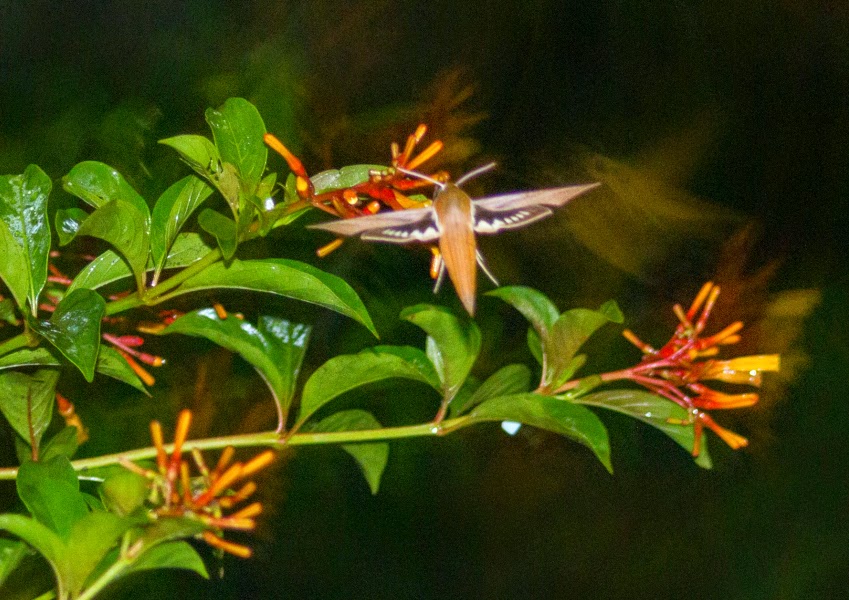

A search online confirmed my conclusion.  This is a Tersa Sphinx.  The Hummingbird Moth belongs to the family of moths technically called the Sphingidae family or Sphinx family of moths. A hummingbird moth can be considered to be a medium to large moth with a wingspan of five (5) or more inches. They tend to fly strong and fast like a hummingbird with rapid wing beats. The hummingbird moth is usually active at dusk. However, they have been known to be active throughout the day traveling from flower to flower, much like a hummingbird. The hummingbird moth will feed on a flower much like a hummingbird. But instead of a beak and tongue to lap the nectar, they have a proboscis which resembles a long, thin straw.  If you look closely at the above photo, you can see the curled proboscis on this moth.  

I wonder what else lurks in the darkness, among my flowering bushes and potted plants...I should investigate more often, there's no telling what I may see.  

Thank you for dropping in...
Have a good week, what's left of it :)